
- Unicrete Building Solutions - An ISI 15477:2019, ISO 9001:2015 & ISO 14001:2015 certified company.

About Unicrete
Adhesive & Sealant: Key Differences and How to Choose for Your Project
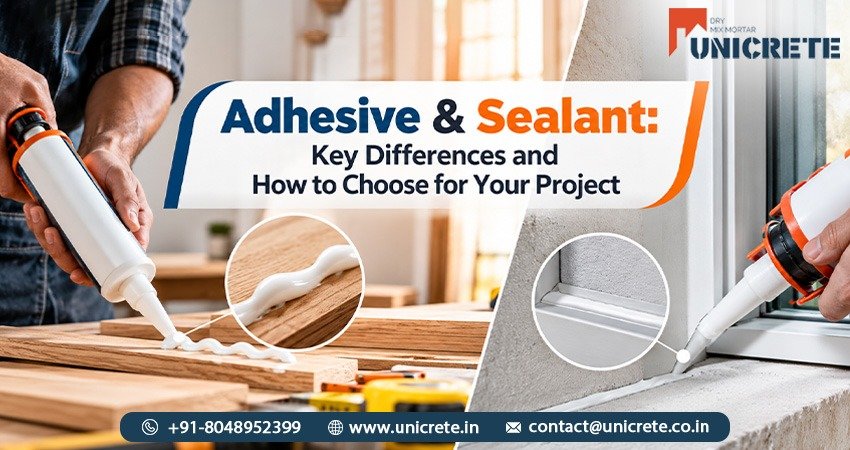
Adhesive & Sealant: Key Differences and How to Choose for Your Project
Adhesive & Sealant - From installing large format tile flooring to sealing gaps in bathrooms to joining stone facings for exterior cladding, the right chemical formulation is the key to the strength and durability of the job. Adhesive and Sealant are sometimes referred to in the same context on job sites but have very different roles in the structural integrity and moisture protection.
Using adhesive where sealant is required lead to cracked joints. Conversely, using a sealant in place of a heavy-duty adhesive risks structural debonding. Understanding the core distinctions between an Adhesive & Sealant allows contractors, engineers and project managers to specify the correct products for every phase of construction.
What Is an Adhesive?
An adhesive is a compound engineered primarily to hold two surfaces together through high shear and tensile bonding strength. Adhesives are used to transfer loads between joined material and to keep the material together even under mechanical load.
In modern construction, specialized polymer-modified mortars, and reactive resins act as high-performance adhesives. For instance, advanced tile adhesives ensure that ceramic, vitrified or natural stone tiles achieve maximum surface contact coverage without sagging or slipping during installation.
What Is a Sealant?
A sealant is a flexible material designed to fill gaps, movement joints, and seams to prevent the passage of water, air, dust and chemicals. Unlike structural adhesives, sealants are engineered to accommodate thermal expansion, structural settling, and continuous vibration without losing adhesion or tearing.
High-performance silicone and polyurethane joint fillers protect vulnerable areas—such as expansion joints, window perimeters, and sanitary fixtures from water ingress and environmental degradation.
Adhesive & Sealant: Direct Comparison
| Parameter | Construction Adhesive | Construction Sealant |
| Primary Purpose | High-strength bonding and load transfer | Gap filling and environmental sealing |
| Flexibility | Rigid to semi-rigid after curing | High elasticity and movement capability |
| Tensile Strength | Very high shear and pull-off resistance | Moderate tensile strength |
| Joint Movement | Low capability; resists movement | High capability (typically ±25% to ±50%) |
| Key Applications | Tile installation, cladding, floor setting | Expansion joints, wet areas, gap filling |
How to Choose for Your Project?
Selecting between an adhesive, and a sealant—or determining if your assembly requires both—depends on three critical job site factors:
1. Load Requirements: For heavy loads, wall tiles, or stone panels, use a dedicated polymer modified adhesive to handle shear, and weight.
2. Joint Movement & Expansion: When two different materials meet or where temperatures swing, joints naturally shift. A flexible elastomeric sealant gives those joints room to expand, and contract without cracking, or pulling away.
3. Moisture & Environment: In wet areas like pools, and commercial kitchens, pair waterproof tile adhesives with specialized epoxy grout, and joint sealants to stop seepage.
Conclusion
Proper knowledge of the different functions of adhesives and sealants helps keep your construction works structurally sound and watertight. The correct bonding agent or joint sealant will avoid re-tiling, water damage and joint failure which would be costly.
If you are looking for the full range of certified Adhesive & Sealant, joint fillers and advanced construction chemicals for residential and commercial projects, check out Unicrete Building Solutions.
Most Searched Keywords:
• Adhesive & Sealant
• Best Adhesive & Sealant
• Top Adhesive & Sealant
• Adhesive & Sealant in India
• Adhesive & Sealant Manufacturers
• Adhesive & Sealant Manufacturers in India
Frequently Asked Questions (FAQ's)
Choose Options
RTL Version
- RTL Version
- LTR Version
Want Sticky Header
- No
- Yes
Dark Verion
- Yes
- No